What Licensing looks at during an RCFE visit
A Licensing visit feels a lot less stressful when you know what the analyst will ask for. Here is what Title 22 says they can look at, and how to have it ready on any given day.
When Licensing walks in
Start a survey visit in seconds: the analyst gets a read-only login on her own device, and you see every page she opens.
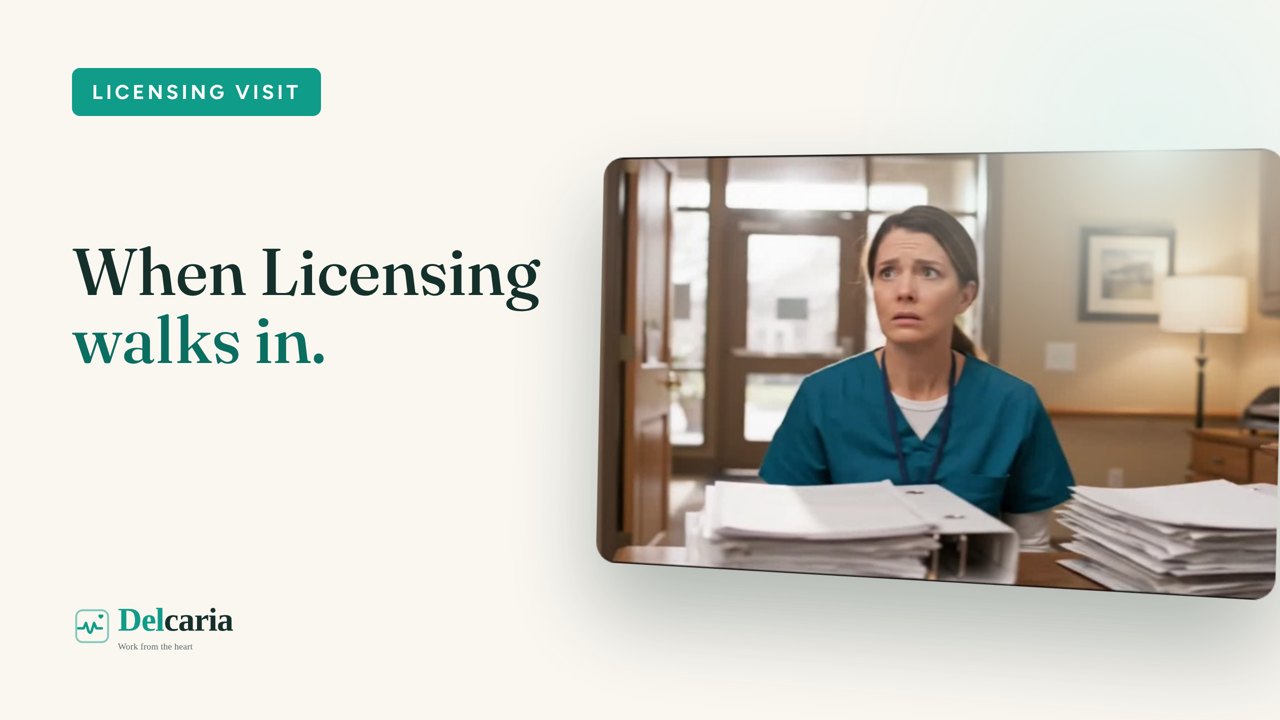
California RCFEs are licensed and inspected by the Community Care Licensing Division of the California Department of Social Services (CDSS). A visit can be announced or unannounced: the state's visit report form, the LIC 809 Facility Evaluation Report, has a box for each. And every visit ends up in a public report, because California law requires one for each licensing visit.
So the goal isn't to get ready the night before. It's to run the building so you're ready every day. These are the four places an analyst almost always looks.
1. Resident records
Title 22 section 87506 says you must keep "a separate, complete, and current record" for every resident. The analyst can ask to see any of it, and the rule is clear: records must be available to inspect, audit and copy "upon demand during normal business hours."
Each record should include, among other things:
- The resident's name, birthdate and admission date
- Emergency contacts, physician and dentist
- The medical assessment and ambulatory status
- The admission agreement and pre-admission appraisal
- Current centrally stored medications
- Records of any cash or valuables you hold for the resident
Keep the original records, or photographic copies, for at least three years after a resident leaves.
2. Appraisals and reappraisals
Section 87463 says a resident's appraisal must be updated in writing "as frequently as necessary or once every 12 months, whichever occurs first." A significant change in condition triggers an update sooner: a fall or other physical trauma, a change in thinking or memory, behavior that could cause harm, a loss like the death of a loved one, or an illness or injury that changes care or diet.
The same section also calls for a routine visit with a licensed medical professional once every twelve months. An expired reappraisal is one of the easiest things for an analyst to spot, because the date is right on the page.
3. Medications
Medications get close attention, and section 87465 is specific:
- Centrally stored medications are kept "in a safe and locked place," in the container they came in. Nothing gets moved between containers, and only the pharmacist changes a label.
- You keep a record of each resident's centrally stored prescriptions for at least one year: the drug, strength and quantity, the prescribing physician, the date filled, the prescription number and the pharmacy.
- Every PRN (as needed) medication needs a signed, dated order from a physician that states the symptoms, the exact dose, the minimum hours between doses and the maximum doses in 24 hours. The label has to say the same.
- When medications are destroyed, the administrator and one other adult who isn't a resident both sign a destruction record, and you keep it for at least three years.
4. Staff files
Section 87412 lists what every personnel file needs, including health screening, criminal record clearance where it applies, and proof of training. For staff who help residents with daily living, the file should show at least ten hours of initial training within the first four weeks of work and at least four hours every year after that, with the trainer, subjects, dates and hours for each.
The rule also asks you to document the hours staff actually worked, and to keep personnel records for three years after someone leaves.
What happens after the visit
The analyst writes up the visit on the LIC 809. If something is out of compliance, it's cited as one of two kinds of deficiency:
- Type A: a problem that, if not corrected, poses "a direct and immediate risk" to residents' health, safety or personal rights.
- Type B: a problem that could become a risk if it isn't corrected, including a recordkeeping problem that would affect care.
Each deficiency comes with a plan of correction and a due date. Fix it by that date and keep proof that you did. Missing the date can lead to a civil penalty.
Before your next visit
- Every resident has a current reappraisal dated within the last 12 months.
- Every PRN medication has a signed, dated order with symptoms, dose, hours between doses and a 24-hour maximum.
- The centrally stored medication record matches what's actually in the locked cart.
- Every staff file shows health screening, clearance and training hours.
- Your destruction records from the last three years are signed by two adults.
- You can pull any resident's file in under a minute.
How Delcaria helps
Delcaria keeps your survey binder current as you work and flags expiring items before an analyst finds them. When Licensing walks in, you give the analyst a read-only link and a one-time code, so they can read the roster, residents' filed papers and your binder on their own device. Every page they open is logged.
See Survey binder and Licensing visits →Sources
- Title 22, section 87506: Resident Records
- Title 22, section 87463: Reappraisals
- Title 22, section 87465: Incidental Medical and Dental Care Services
- Title 22, section 87412: Personnel Records
- CDSS notice on the LIC 809 Facility Evaluation Report
- CDSS Community Care Licensing Division
This article is general information for California RCFE owners, not legal advice. Rules change, so check the current regulation text or ask your Licensing office before you rely on it.